Cisco DNA Center / Catalyst Center: When It Makes Sense and When It Doesn’t
Cisco DNA Center — now rebranded as Catalyst Center — is one of those platforms where the marketing story and the field reality diverge significantly. The marketing story is compelling: a single pane of glass for your entire campus network, automated provisioning, AI-driven analytics, intent-based networking. The field reality is that getting to that state requires substantial investment, considerable upfront effort, and an organizational readiness that many companies underestimate.
I’ve deployed DNA Center in large enterprise environments, including a manufacturing deployment that Cisco published as a success story — one of the first large-scale DNA Center and Stealthwatch integrations in Turkey. That experience gave me a clear picture of both what the platform genuinely delivers and where it creates friction.
This article is an honest architectural assessment — not a product pitch and not a dismissal. The question isn’t whether DNA Center is good or bad. It’s whether it’s the right tool for your specific situation.
What DNA Center / Catalyst Center Actually Is
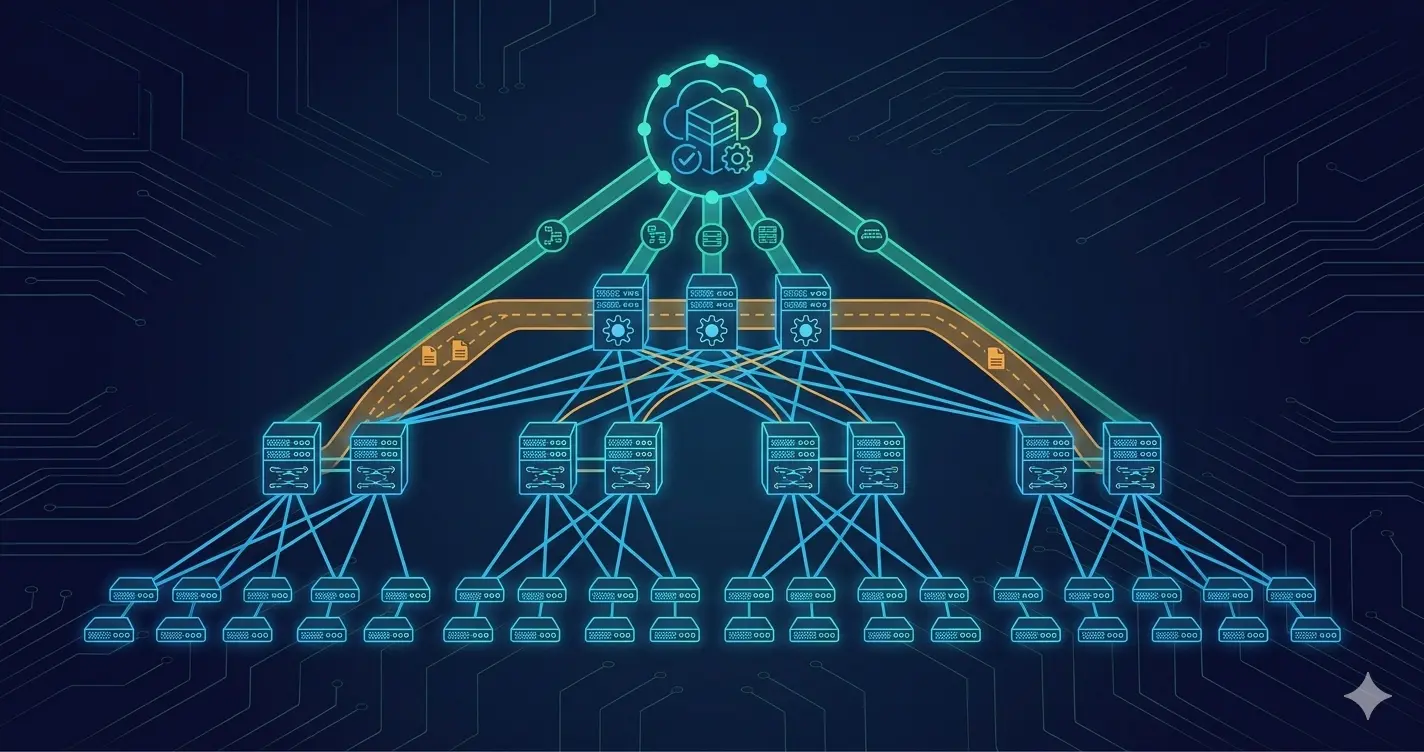
DNA Center is a network management, automation, and assurance platform. It runs on dedicated physical appliances and provides centralized control over the entire campus network:
- Design: Define network hierarchy — sites, buildings, floors — and apply settings at scale
- Policy: Define who gets access to what, with policies enforced consistently across wired and wireless
- Provision: Deploy configurations to switches, APs, and routers automatically from templates
- Assurance: Collect telemetry from all managed devices, provide health dashboards, client experience metrics, and anomaly detection
- Automation: Workflows, ITSM integration, automated remediation
The underlying campus fabric technology is SD-Access — Cisco’s software-defined campus architecture that uses VXLAN for the data plane and LISP for the control plane, with ISE as the policy engine. DNA Center is the management platform that orchestrates this fabric.
The Cost Reality: This Is an Enterprise Investment
Let’s address the most important factor first, because it determines whether everything else is even relevant for your situation.
Hardware Appliance Cost
DNA Center runs on Cisco’s dedicated DN2-HW-APL appliance. A single-node deployment (suitable for smaller environments) is one appliance. A production-grade cluster requires three appliances — one for management, one for policy, one for data collection — configured in an HA cluster.
The hardware cost for a three-node cluster is substantial. Before software licensing, you’re talking about a significant capital investment that immediately prices DNA Center out of small and mid-sized deployments. This is not a platform you deploy because it would be nice to have — you deploy it because the scale of your environment justifies it.
Software Licensing
DNA Center licensing is subscription-based, per-device, per-year. The licensing tiers (Essentials, Advantage, Premier) determine which features are available. The full feature set — including advanced assurance, AI analytics, and SD-Access capabilities — requires the higher tiers.
For an organization with 500 switches, the annual licensing cost adds a significant ongoing operational expense on top of the hardware investment.
The Honest Size Threshold
From field experience: DNA Center starts to make economic and operational sense when you have a large number of switches — typically in the range of several hundred or more managed devices across multiple sites. Below that threshold, the cost-benefit calculation is difficult to justify.
For small and medium-sized organizations, the investment required for DNA Center — hardware, licensing, implementation time, training — is better allocated elsewhere. A well-designed traditional campus with good monitoring tools delivers similar day-to-day operational value at a fraction of the cost.
The key question before any DNA Center evaluation: How many network devices are you managing, across how many sites, with how many engineers? If the answer is “fewer than a few hundred devices, one or two sites, one network team,” look at alternatives first.
The Deployment Reality: Complex, Time-Consuming, Unforgiving
The second major factor that surprises organizations is how involved the initial deployment and configuration is.
Initial Setup Is Not Quick
Standing up a DNA Center cluster, integrating it with your existing network, and getting to a functional state is a multi-week project — not a weekend task. The process involves:
- Physical appliance installation and cluster formation
- Network hierarchy definition (site, building, floor structure)
- Device discovery and onboarding
- Template design for device configurations
- Integration with ISE (if using policy features)
- Wireless integration if managing APs
- Assurance data collection configuration
Each of these steps has dependencies. Template design requires understanding how your network should look and encoding that as reproducible configuration — which means the work of network standardization that should have been done before DNA Center must be completed as part of the deployment.
The Prerequisite Problem
DNA Center assumes a degree of network standardization that many real-world environments don’t have. If your switches have inconsistent configurations, non-standard naming conventions, or legacy setups that evolved organically over years, DNA Center deployment forces you to address all of that before the platform can manage devices reliably.
This is actually a benefit in disguise — DNA Center forces good practices. But it means the deployment project is often longer than planned because the pre-work is larger than expected.
Deploy and Forget Is Not an Option
DNA Center is not a platform you set up once and leave running. It requires ongoing attention:
- Software updates to the appliance itself (regular maintenance windows)
- Template updates when network standards change
- ISE policy updates when access requirements evolve
- Monitoring the platform’s own health alongside the network it manages
Organizations that deploy DNA Center without dedicated resource to operate it find that the platform’s value degrades over time as it falls out of sync with the actual network state.
What You Get After Stabilization: The Genuine Value
Once DNA Center is deployed, configured, and stabilized — which takes time and effort — the operational picture changes significantly. This is where the platform earns its cost.
Single Pane of Glass for Wired and Wireless
The most immediate operational benefit: everything is visible in one place. Wired switches, wireless APs, routers, WAN connectivity — all managed and monitored from a single interface. You see the network as a whole, not as disconnected domains managed by separate tools.
This sounds simple, but in large environments where the wired team and the wireless team historically used different tools and had different visibility, the unified view genuinely changes how problems are diagnosed. A client connectivity issue that previously required correlating data from multiple sources can be traced through the full path — from client to AP to switch to firewall — in a single workflow.
Built-In Logging and Historical Analysis
DNA Center collects and retains telemetry from managed devices. Interface statistics, client connection history, topology changes, configuration changes — all logged and queryable.
The practical value: when something went wrong at 2am last Tuesday, you can go back and see exactly what the network looked like at that time. Interface utilization, client counts, error rates, configuration state. This retroactive visibility is something that traditional network management often lacks — devices keep logs internally, but correlating them across hundreds of devices after the fact is manual and slow.
This also means you don’t necessarily need a separate third-party logging platform for network device data. DNA Center handles that function for managed devices, reducing the number of tools in the stack.
Automation: The Operational Multiplier
Once templates and workflows are established, provisioning new devices or sites becomes dramatically faster. Adding a new building to an existing campus that’s fully managed by DNA Center involves:
- Physically connecting the new switches
- Running device discovery
- Applying the existing site template
- Done
What would previously require manual configuration of each device from a terminal session — potentially days of work for a large site — becomes hours or less when the template work is already done.
The same applies to bulk changes: updating a VLAN across 200 switches, applying a new QoS policy network-wide, rotating credentials across all managed devices. Operations that previously required scripting or manual repetition become template-driven workflows.
Fabric Architecture: VXLAN Over Your Campus
For organizations deploying SD-Access fabric, DNA Center is the management layer over a fundamentally different campus architecture. In a traditional campus, VLANs are extended across switches using 802.1Q trunking — the Layer 2 domain is physically constrained by the network topology.
SD-Access uses VXLAN to overlay virtual networks over a routed underlay. The result: any endpoint can be in any virtual network regardless of physical location, VLANs don’t need to be extended across the physical network, and macro-segmentation is enforced at the fabric edge rather than at the firewall.
For large campuses with complex segmentation requirements — different departments, IoT devices, guest networks, all needing isolation — the fabric model simplifies the architecture significantly compared to managing extended VLANs and inter-VLAN routing manually.
ISE Integration: Where the Platform Becomes Exceptional
If DNA Center deployed alone is powerful, DNA Center integrated with Cisco ISE is a fundamentally different level of capability.
ISE provides the identity and policy engine. DNA Center provides the network management and enforcement platform. Together:
- A user connects to the campus network (wired or wireless)
- ISE authenticates them via 802.1X against Active Directory
- ISE determines their security group (SGT) based on identity, device type, and posture
- DNA Center enforces the policy associated with that security group across the entire fabric
- The policy follows the user regardless of where they connect — building A, building B, wired, wireless
This is identity-based networking in its most complete form. The access policy is tied to who the user is and what device they’re using, not to which physical port or IP subnet they’re on. A finance user gets finance-level access whether they’re at their desk, in a conference room, or plugged in at a remote office.
The operational implication: network segmentation stops being a physical problem (which VLAN is this port in?) and becomes a policy problem (what should this user be allowed to access?). This simplification has real value in environments with complex access requirements.
When I deployed this in the manufacturing environment, the combination of DNA Center, ISE, Umbrella, Stealthwatch, and Firepower created a fully integrated security and network fabric. Policy changes made in ISE propagated automatically through DNA Center to the entire network. Visibility from Stealthwatch fed anomaly detection that triggered automated responses. This level of integration — across a campus with hundreds of devices — would be impossible to maintain manually.
Cloud Integration: AWS and Beyond
DNA Center has added cloud integration capabilities that expand its relevance beyond the on-premise campus.
AWS integration allows DNA Center to extend network policies and visibility to cloud workloads. Transit Gateway integration, VPC connectivity management, and consistent policy across on-premise and AWS environments are part of the platform’s direction.
Cisco’s broader vision — and the trajectory the platform is moving toward — is consistent policy and visibility across on-premise campus, branch networks, and cloud environments from a single management plane. Azure and other cloud providers are in the roadmap.
This is still evolving. The on-premise campus management is mature; the multi-cloud integration is newer and continues to develop. But for organizations with significant cloud presence that are also running Cisco campus infrastructure, this convergence is worth tracking — it’s the direction Cisco is investing.
DNA Center vs. Traditional Campus: The Architecture Decision
When does traditional campus management make more sense than DNA Center?
Traditional campus (managed switches, separate tools) is appropriate when:
- Device count is below the scale threshold where automation delivers clear ROI
- The organization doesn’t have engineering resources to deploy and maintain DNA Center properly
- Budget constraints make the hardware and licensing investment difficult to justify
- The network is stable and standardized — change frequency is low
- Multi-vendor environment where Cisco doesn’t dominate
DNA Center makes sense when:
- Large device count (hundreds of switches, multiple sites)
- Frequent provisioning of new sites or devices
- Complex segmentation requirements that benefit from fabric architecture
- ISE is already deployed or planned — the integration multiplies value
- Engineering team capacity to operate the platform properly
- Organization is committed to the Cisco ecosystem long-term
The worst outcome is deploying DNA Center for an environment where the scale doesn’t justify it, then struggling with the operational overhead of a complex platform that doesn’t deliver proportional value. The second-worst outcome is having a network large enough to benefit from DNA Center but not allocating the engineering resources to operate it properly.
Practical Observations from the Field
A few things that don’t appear in documentation but matter in practice:
Start with network standardization. Before deploying DNA Center, audit your existing network configuration. Inconsistent hostname conventions, non-standard VLAN structures, and legacy configurations will slow down device onboarding significantly. DNA Center rewards clean, standardized networks.
Template design is the real work. The time investment in building good configuration templates pays dividends for years. Rushed templates lead to manual overrides and exceptions that erode the automation value. Take the time to design templates properly at the start.
The cluster is not optional for production. A single-node deployment is not appropriate for production environments — it’s a single point of failure for your network management platform. Budget for the three-node cluster from the beginning.
ISE integration requires ISE expertise. Integrating DNA Center with ISE unlocks the platform’s full capability, but ISE itself is complex. The integration project assumes working ISE knowledge on the team. If ISE is being deployed alongside DNA Center for the first time, plan for the combined learning curve.
Upgrade planning matters. DNA Center upgrades require maintenance windows and careful planning. Running the appliance on an old software version accumulates security debt and feature gaps. Build regular upgrade cycles into the operational calendar.
Key Takeaways
- DNA Center is expensive — the three-node cluster for production HA is a significant hardware investment before any software licensing. This cost is only justified at scale.
- Initial deployment is complex and time-consuming — plan for weeks, not days, and plan for pre-work on network standardization.
- Once stabilized, the operational value is real — unified visibility, built-in logging, automation, and fabric management genuinely change how large networks are operated.
- ISE integration is where the platform becomes exceptional — identity-based policy enforced across the entire campus, following users regardless of connection point.
- Built-in logging reduces third-party tool dependency — DNA Center retains network telemetry, reducing the need for separate logging infrastructure for network device data.
- Cloud integration is growing — AWS connectivity is available, with broader multi-cloud support in development.
- For small and medium organizations: look elsewhere. The investment is disproportionate to the benefit at lower device counts. Traditional campus management with good monitoring tools is the right answer.
- The product continues to evolve — Cisco is actively investing in the platform. Capabilities that were limited when first deployed are more mature with each release.
Related Articles
- 🔐 802.1X Identity-Based Architecture in the Field — The identity foundation that makes DNA Center + ISE powerful
- 🔐 The Zero Trust Mindset: Engineering Security as an Architecture — The architectural philosophy behind SD-Access policy model
- 🏗️ Switch, Firewall, AP — Why Choosing the Right Products Is Not Enough — Campus architecture context
- 📊 Monitoring Done Right — How DNA Center assurance fits into broader monitoring strategy
- 🌐 Enterprise WiFi Controller Architecture — Wireless integration with DNA Center