Hello friends! You’ve just graduated, you have your diploma in hand, and a vast IT world lies ahead of you. While wondering “Which path should I take?”, you came across Network Engineering. So, do these people just plug in cables, or is there a massive intelligence behind the scenes? Let’s dive deep into this invisible heroism of the digital world.
🕸️ What is a Network? (A Journey on the Digital Highway)
In its simplest terms, a network is a transport vehicle that allows systems to communicate with each other. It enables computers to function not as independent islands, but as a massive, interconnected continent.
Why Isn’t a USB Drive Enough? You might use a USB drive to transfer an Excel file or a video to the computer in the next room at home. However, that’s not how things work in the professional world. Imagine you are in an office where 50 people are working on the same file, or you need to send data to a colleague in another city or even another country. In any scenario where the distance is too far or the crowd is too large for manual transfer, the Network—the digital highway—kicks in.
🏭 The Factory Example: “The Server Room” as the Heart of the System
Imagine you are in a factory. The entire memory of the factory is stored on a server in the system room: customer lists, invoices, production stocks, and employee data. Let’s assume there are 100 people in the factory. Each of these 100 people must be able to access this server from their own desk simultaneously, without errors, and at high speed.
The Network Engineer is the person who builds the road between those 100 people and that server, ensures the traffic doesn’t get congested, and secures that path. As I often emphasize on my site; this is not just about “placing three or five boxes side by side,” it is about designing operational integrity. In today’s world, this structure is managed not only with physical cables but also with smart software layers like SD-WAN and Cloud integrations.
🏠 Home Modem vs. Industrial Infrastructure
Most of us have a modem at home, and all we do is plug it in to connect to the internet. However, in the corporate world (hospitals, hotels, plazas), these home devices are like toys:
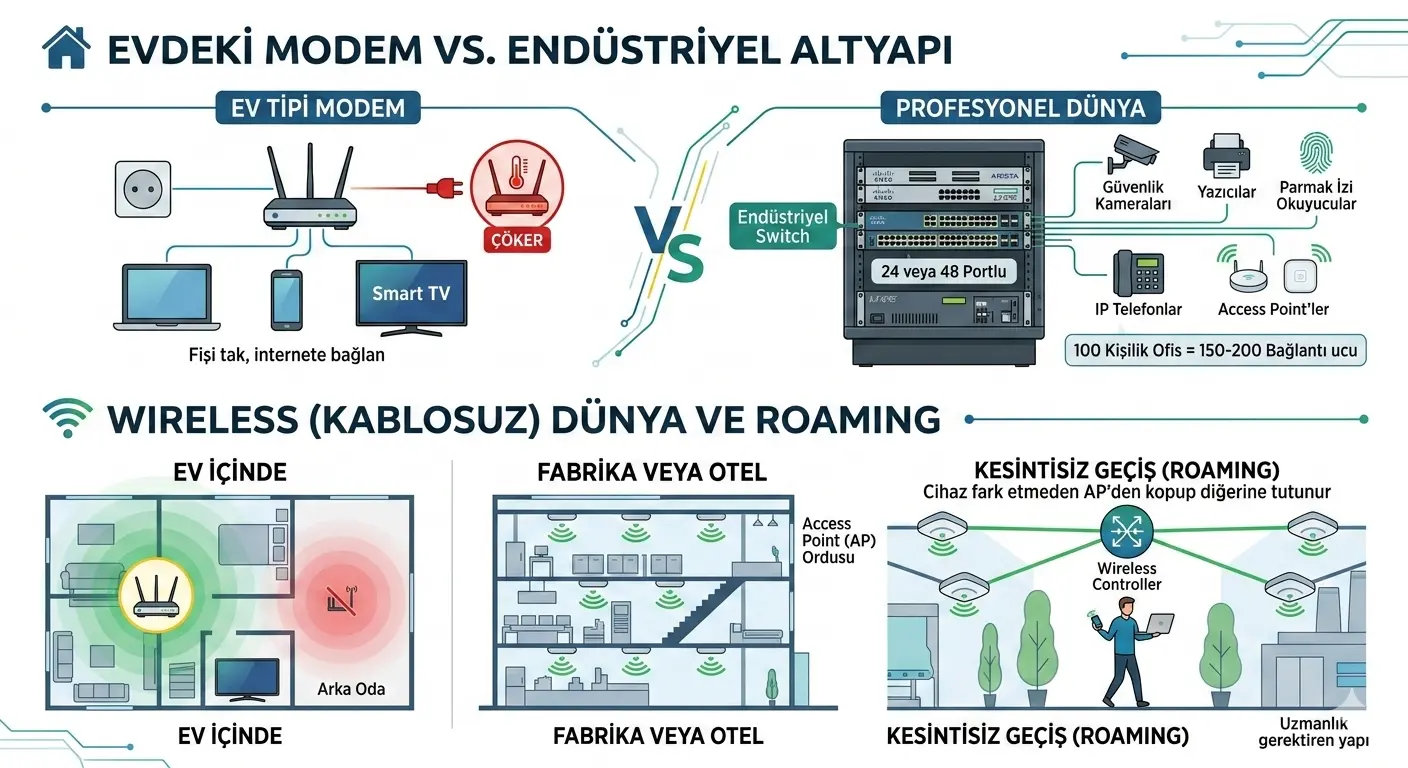
- Industrial Product Selection: A home-type modem will overheat, lock up, and crash when it tries to get 100 people online at once. That’s why in the professional world, we use “Industrial Switches” from global giants like Cisco, Arista, HPE (Aruba), or Juniper.
- Ports and Connectivity: These devices usually have 24 or 48 ports. When you say an office of 100 people, don’t just count the laptops; security cameras, printers, fingerprint readers, IP phones, and Access Points are also connected to these switches. This means an office of 100 people is actually 150–200 different cable ends and connections for you to manage.
📶 Wireless World and Roaming
At home, the internet works fine near the modem but drops off in the back room. You cannot solve this with a single device in a factory or a 10-story hotel.
- Army of Access Points (AP): Dozens, sometimes hundreds, of Access Points are installed on ceilings, in warehouses, and in offices.
- Seamless Transition (Roaming): Imagine walking from one end of a factory to the other while on a call with your laptop. The internet must not drop for even a second. Your expertise lies in setting up and managing that smart structure (Wireless Controller) that allows your device to drop one AP and latch onto another without you even noticing.
🛡️ The Gatekeeper of the Internet: Firewall and Leased Lines
Corporate internet operates under much different rules than home internet:
- Metro Ethernet (Dedicated): At home, the internet slows down in the evening because you share the line with your neighbors. In companies, “Dedicated” (exclusive to you) lines are used. Your speed is always constant, and most importantly, your Upload speed is very high.
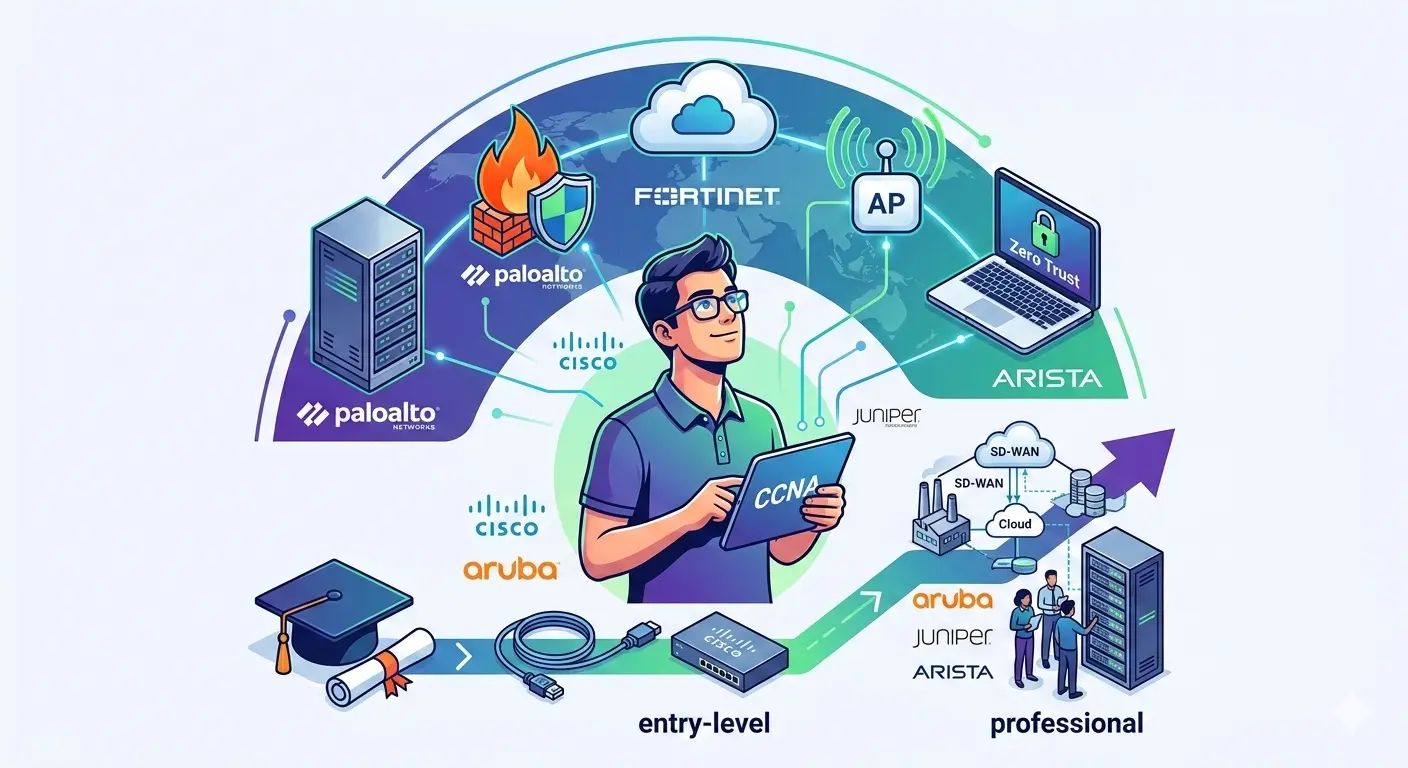
- Firewall: We place a sentry at the entrance of this valuable internet line. With brands like Palo Alto, Fortinet, or Check Point, you implement who can access which site, how external cyberattacks are blocked, and the Zero Trust philosophy I describe on my site.
🌙 The Other Side of the Coin: Shifts and Responsibility
If you are going to be a network engineer, you must accept this reality: “The system is never shut down while everyone is working.”
- Maintenance Windows: If you are going to update the software inside a switch or change the location of cables, you can’t do this while everyone is in the office. This is why work is often done during late-night hours, weekends, or public holidays.
- Sleepless Nights and Rights: Your phone might ring at 3:00 AM if the system crashes. However, in the professional world, this is a sacrifice, and companies usually balance this by offering overtime pay or “service time” (extra time off) during the week. If you worked 3 hours at night, you might have the right to leave 3 hours early on a weekday.
🎓 Roadmap: How to Become a Network Engineer?
This profession is learned not just by reading, but by doing and following globally recognized paths:
- The Foundation of Certification: CCNA This is the “driver’s license” of the network world. Cisco Certified Network Associate (CCNA) training allows you to learn the alphabet of the business (IP, Routing, Switching).
- Official Education Portals (The Treasure Trove!)
Manufacturers offer great resources for you to learn their devices:
- Cisco Networking Academy (Skills for All): skillsforall.com
- Palo Alto Networks Education: learning.paloaltonetworks.com
- Fortinet Training Institute: training.fortinet.com
- Aruba (HPE) Learning Center: learn.hpe.com/aruba
- Juniper Learning Portal: learningportal.juniper.net
- Online and Self-Learning
- Udemy: You can find very affordable CCNA courses in many languages.
- CBT Nuggets: The video explanations are of very high quality.
- Simulation Tools: Don’t just read books! Install Cisco Packet Tracer on your computer. For more advanced levels, use GNS3 or EVE-NG to experience professional device software.
Conclusion
Networking is the foundation of computing. Whether you are a developer or a cybersecurity specialist, you cannot be a true professional without knowing how a packet gets from point A to point B. If you love solving complex puzzles and building the infrastructure of digital worlds, Network Engineering is a prestigious and exciting career path that is always in demand.