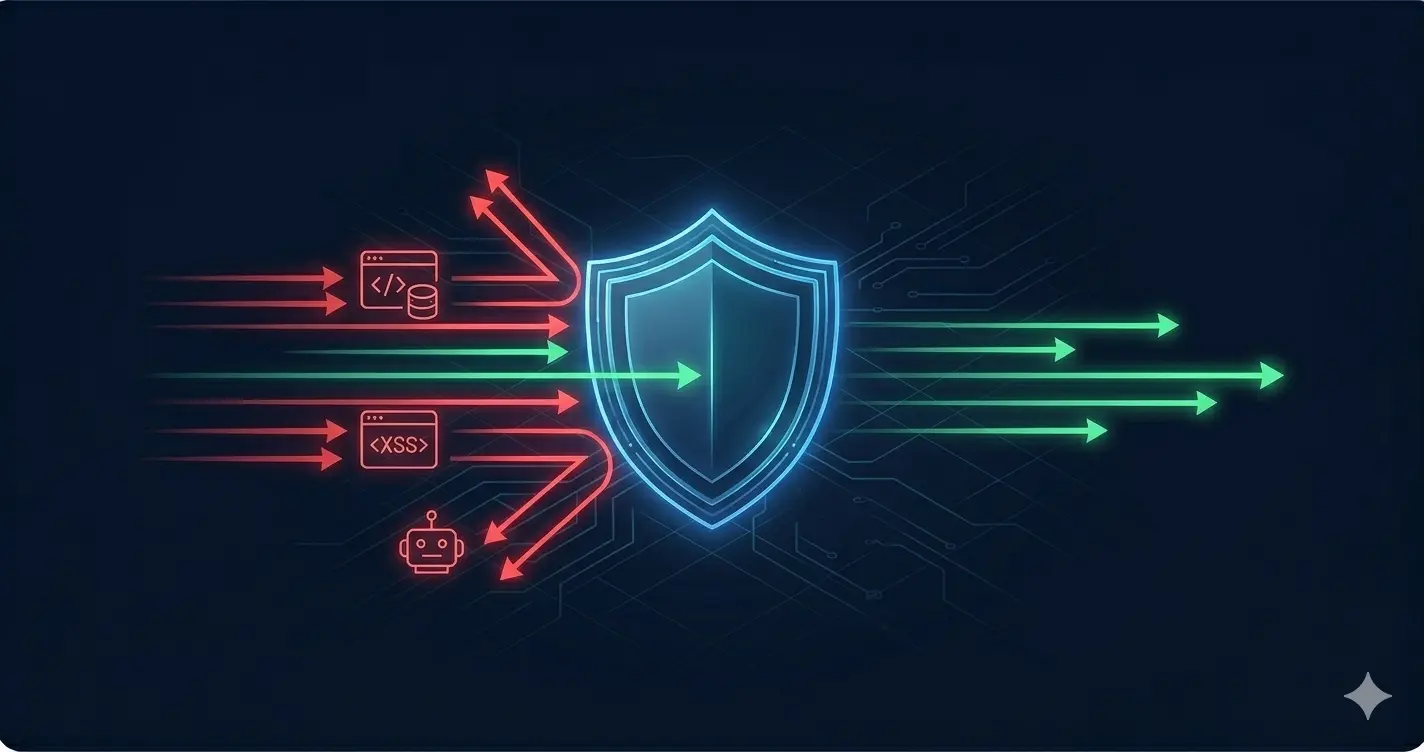
F5 WAF Deep Dive: Application Security with ASM and Advanced WAF
This article is part of the F5 BIG-IP series.
New to F5? Start with the platform overview first: F5 BIG-IP Is Not a Load Balancer — It’s an Application Delivery Platform
If you already understand the big picture and want to go deep on WAF — security models, OWASP coverage, bot defense, and deployment strategy — you’re in the right place.
Where WAF Fits — and Where It Doesn’t
The most common misconception: “We have a firewall, so we’re protected at the application layer.”
A next-generation firewall operates at L3/L4 with some L7 protocol awareness. It blocks port scans, known-bad IPs, C2 communication, and recognized exploits in clear-text protocols. But it cannot inspect the body of an HTTPS POST request and determine whether the username field contains ' OR 1=1 --.
That is the gap WAF fills:
NGFW:  IP filtering, port rules, VPN, stateful inspection, protocol anomaly
WAF:   HTTP/HTTPS content inspection — SQL injection, XSS, parameter tampering,
       bot traffic, credential stuffing, application-layer DoS
F5 WAF sits inline on the LTM virtual server. Traffic flows through LTM’s full proxy, SSL is terminated, and then WAF inspects the decrypted content before it reaches the backend. This positioning is the key advantage — WAF sees everything, including traffic that was encrypted all the way from the client.
ASM vs. Advanced WAF
F5 offers two WAF tiers on BIG-IP:
ASM (Application Security Manager) — the original module. Primarily signature-based. Covers OWASP Top 10, parameter enforcement, cookie protection, and basic bot detection. Included in many standard BIG-IP licenses.
Advanced WAF (AWAF) — the newer module with behavioral capabilities ASM lacks:
| Capability | ASM | Advanced WAF |
|---|---|---|
| Signature-based attack detection | ✅ | ✅ |
| OWASP Top 10 coverage | ✅ | ✅ |
| Parameter and cookie enforcement | ✅ | ✅ |
| Basic bot detection (signatures) | ✅ | ✅ |
| Behavioral bot defense | ❌ | ✅ |
| Credential stuffing protection | ❌ | ✅ |
| JavaScript challenge / CAPTCHA | Limited | ✅ |
| L7 behavioral DoS mitigation | Limited | ✅ |
| API security (OpenAPI / Swagger) | Limited | ✅ |
| DataSafe (client-side encryption) | ❌ | ✅ |
For internal enterprise applications, ASM provides solid coverage. For public-facing applications with high bot exposure, credential stuffing risk, or aggressive L7 DoS — Advanced WAF is significantly more effective.
Security Policy Models
Negative Security Model (Blacklist Approach)
Block known-bad patterns. Allow everything else.
F5 WAF ships with thousands of attack signatures matching known exploit patterns:
Signature: SQL Injection (Generic)
  Attack Type:  SQL Injection
  Risk:         Critical
  Pattern:      Matches SELECT...FROM, INSERT...INTO, OR 1=1, etc.
When a request matches a signature, WAF blocks it (in blocking mode) or logs it (in transparent mode).
Advantages: Fast to deploy, low initial false positives, good coverage for known vulnerabilities.
Disadvantages: Cannot detect zero-day attacks by definition. Determined attackers can sometimes evade signatures through encoding variations or fragmented payloads.
Positive Security Model (Whitelist Approach)
Allow only explicitly defined inputs. Block everything else.
In positive security, you define exactly what your application accepts:
Parameter: username
  Type:        Alpha-Numeric
  Max Length:  64
  Required:    Yes

Parameter: user_id
  Type:        Integer
  Min Value:   1
  Max Value:   999999
A request with username=admin' OR 1=1-- is blocked because the single quote and spaces are not in the Alpha-Numeric character set. The attacker cannot craft a payload that bypasses a strict whitelist.
Advantages: Blocks zero-days and unknown attack variants. Fundamentally stronger than signature matching.
Disadvantages: Significant tuning effort required. Applications with complex, dynamic parameter sets are difficult to model accurately. High false-positive rate initially.
Hybrid Model: What Production Environments Actually Use
Most production deployments use a combination:
- Negative model for the majority of the application — signatures with low maintenance overhead
- Positive model for high-risk endpoints — authentication, payment processing, administrative functions where strict input validation is worth the tuning investment
Attack Signatures: Management and Updates
F5 ships signatures organized by attack category and application platform:
Signature Sets:
  Generic Detection Signatures (SQL Injection, XSS, Command Injection)
  Apache Struts Signatures
  WordPress / Joomla Signatures
  CVE-specific signatures (targeted exploit payloads)
  High Accuracy Signatures (tuned for minimal false positives)
F5 releases signature updates regularly. Outdated signatures significantly reduce WAF effectiveness against recently disclosed vulnerabilities.
Signature staging — new signatures should be placed in staging mode before enforcement:
New Signature State: Staging
  Behavior: Log violations, do not block
  Purpose:  Verify no false positives before enabling enforcement
  Duration: Minimum 1–2 weeks of production traffic observation
Staging lets you validate new signatures against your specific application traffic before they affect production users.
OWASP Top 10 Coverage
F5 WAF addresses all ten OWASP Top 10 categories through a combination of signatures and policy enforcement:
A01 — Broken Access Control: Enforce URL access patterns, block requests to administrative paths from unauthorized sources.
A02 — Cryptographic Failures: Detect sensitive data patterns (credit card numbers, SSNs) in responses; block inadvertent exposure.
A03 — Injection (SQL, Command, LDAP, XSS): Primary strength of signature detection. Hundreds of signatures specifically targeting injection payloads across all injection types.
A04 — Insecure Design: Enforce expected application flows; block forced browsing to URLs outside defined navigation paths.
A05 — Security Misconfiguration: Detect and block access to default admin interfaces, backup files, configuration endpoints, and version disclosure pages.
A06 — Vulnerable Components: Signature coverage for known CVEs in popular frameworks (Apache Struts, Spring, Log4j, etc.).
A07 — Authentication Failures: Advanced WAF adds credential stuffing protection — detecting and rate-limiting automated credential testing attacks.
A08 — Software & Data Integrity Failures: Limited direct WAF coverage — primarily an application design concern. WAF can detect some injection attempts that exploit deserialization.
A09 — Logging & Monitoring Failures: WAF provides detailed request logging and violation tracking, integrating into SIEM for centralized visibility.
A10 — SSRF (Server-Side Request Forgery): Signatures match common SSRF patterns in request parameters and headers.
Bot Defense (Advanced WAF)
A significant portion of internet traffic is automated. Not all bots are malicious — search engine crawlers, monitoring systems, and RSS readers are legitimate. Advanced WAF’s bot defense distinguishes between them.
Detection Layers
Signature-based bot detection: Match known bot User-Agent strings against F5’s bot database. Fast but trivially bypassed by changing the User-Agent header.
JavaScript challenge: Inject a transparent JavaScript challenge into the response. Legitimate browsers execute it silently; basic bots that don’t render JavaScript fail the challenge. Significantly more effective than signature matching alone.
CAPTCHA challenge: For traffic that fails the JS challenge or matches suspicious patterns, present a CAPTCHA. Used as a secondary challenge — not as the primary defense (too disruptive for normal traffic).
Behavioral analysis: Track request patterns across time. A client making 500 requests per second to /api/auth/login is almost certainly a bot — regardless of whether it passes the JavaScript challenge.
Browser fingerprinting: Advanced WAF collects browser characteristics (canvas rendering, JavaScript engine timing, TCP/TLS fingerprint) to distinguish real browsers from headless automation tools (Puppeteer, Playwright, Selenium).
Bot Categories and Responses
Bot Category           Response
─────────────────────────────────────
Search engines         Allow (verified via DNS reverse lookup)
Monitoring tools       Allow (whitelisted by IP)
Unknown bots           JS challenge
Suspicious bots        CAPTCHA challenge
Known malicious bots   Block immediately
Credential stuffers    Block + alert
L7 DoS Protection
Layer 7 DoS attacks don’t need large volumes of traffic. A small number of requests targeting a slow endpoint can exhaust server resources:
Attack example:
  100 concurrent requests to /reports/generate?type=full
  Each triggers a 30-second database query
  Database CPU → 100%
  All other users: timeouts
  Network bandwidth consumed: minimal
  Traditional DDoS detection: sees nothing unusual
Advanced WAF’s L7 DoS detection:
Stress-based detection: Monitors backend server response latency as the primary signal. When latency increases above baseline, WAF automatically applies rate limiting. This is adaptive — it responds to actual server stress, not just request volume thresholds.
TPS-based detection: Enforces requests-per-second limits per source IP or per URL.
Behavioral baseline: Learns normal traffic patterns per URL over time. Automatic alerting when a URL deviates significantly from its learned baseline — a URL normally receiving 20 requests/minute suddenly receiving 5,000 is anomalous regardless of absolute numbers.
Deployment Strategy: The Transparent-to-Blocking Path
The most common WAF deployment failure is going directly to blocking mode. Every false positive in blocking mode breaks a legitimate user’s workflow, generates helpdesk tickets, and destroys organizational confidence in the WAF before it proves its value.
The correct approach is always phased:
Phase 1 — Transparent Mode (Weeks 1–4)
Enforcement Mode: Transparent
Action on violation: Log only — no blocking
Deploy and collect. Review violation logs daily. Identify:
- Legitimate application behavior triggering signatures (false positives)
- Actual attacks being detected (true positives)
- Typical values and patterns for each application parameter
Phase 2 — Policy Tuning (Weeks 2–6, overlapping with Phase 1)
Based on transparent mode data, tune the policy:
Add exceptions for confirmed false positives:
Parameter: search_query
  Allow: Special characters (%, *, ?)
  Reason: Application legitimately accepts wildcard search operators
Stage new or problematic signatures instead of disabling:
Signature: XSS Generic (high false positive rate for this app)
  Status: Staging → log but don't block
  Review after: 2 additional weeks of data
Create positive security rules for critical endpoints:
URL: /api/auth/login
  username  → Alpha-numeric, max 64 chars
  password  → Any, max 128 chars, never log value
  mfa_code  → Numeric only, exactly 6 chars
Phase 3 — Selective Blocking (Week 6+)
Enable blocking mode incrementally — start with highest-confidence signatures:
Enforcement Mode: Blocking
High-confidence signatures: Block
Medium-confidence signatures: Alarm only (log + alert, no block)
New/recently added signatures: Staging
This prevents a wave of false positives when transitioning from transparent to blocking. Move signatures through the pipeline: Staging → Alarm → Blocking as confidence grows.
Phase 4 — Ongoing Maintenance
WAF is not a set-and-forget tool:
- Monthly: Apply F5 signature updates; review new signatures in staging
- On each application deployment: Update WAF policy for new parameters, URLs, or changed application behavior
- Weekly: Review violation log trends; investigate spikes and new attack patterns
- Quarterly: Full false-positive audit; remove stale exceptions; review bot traffic trends
Logging and SIEM Integration
WAF generates detailed logs for every violation — essential for incident response, compliance, and threat intelligence:
Timestamp:          2026-03-14 09:23:41 UTC
Client IP:          203.0.113.42
Request:            POST /api/auth/login HTTP/1.1
Violated Parameter: username
Violation:          SQL Injection
Matched Signature:  200000007 (SQL Injection Generic)
Attack Type:        SQL Injection
Severity:           Critical
Action:             Blocked
Support ID:         12345678901234
In the banking environment, WAF logs were forwarded to Splunk for:
- Real-time attack dashboards visible to the SOC
- Correlation with firewall and IPS events — an IP triggering WAF violations AND IPS alerts simultaneously is high-priority
- Automated paging for Critical-severity violations
- Monthly PCI DSS compliance reporting
Key Takeaways
- WAF protects at L7 — the layer that NGFWs cannot inspect effectively for application-specific attacks.
- ASM covers standard enterprise needs. Advanced WAF is justified for public-facing applications with bot exposure, credential stuffing risk, or L7 DoS threats.
- Never go directly to blocking mode. Transparent → tuning → selective blocking → full blocking is the only reliable path.
- Negative model deploys quickly. Positive model is stronger but requires significant tuning investment — apply it selectively to high-risk endpoints.
- WAF requires ongoing maintenance — signature updates, policy changes when the application changes, regular false-positive review.
- SIEM integration transforms WAF from a blocking tool into an intelligence source for the entire security operations function.
This Series
- 📖 F5 BIG-IP Platform Overview — All Modules ← Start here if you’re new to F5
- 🔧 F5 LTM Deep Dive
- 🌐 F5 GTM & GSLB Deep Dive
Related Articles
- 🔐 The Zero Trust Mindset: Engineering Security as an Architecture — Where WAF fits in Zero Trust
- 🛡️ 802.1X Identity-Based Architecture in the Field — Defense in depth across network layers
- 📊 Monitoring Done Right — Integrating WAF logs into proactive monitoring
- 🛡️ Network Packet Broker (NPB) Masterclass — Full traffic visibility alongside WAF